

OWON XDS4000 Series
Seven instruments in one box: a 350 or 500 MHz oscilloscope sampling at 5 GSa/s into a 400M record, with a 50 MHz arbitrary waveform generator, FFT analyser, frequency counter and Bode plotter built in — all on a 10.4-inch multi-touch screen. From €1592.
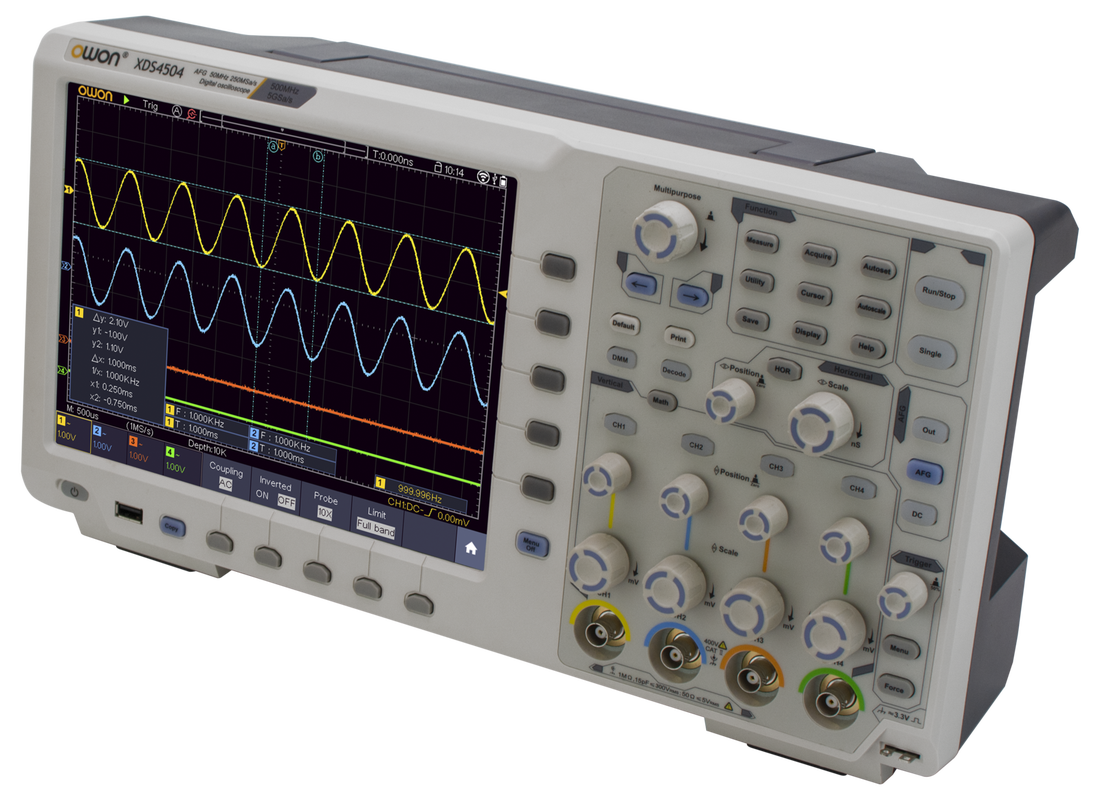
The fastest bench scope OWON makes
The XDS4000 sits at the top of the OWON benchtop range. Four models cover 350 and 500 MHz in 2- or 4-channel form, all sampling at up to 5 GSa/s on a single channel and holding a 400M-point record — deep enough to capture milliseconds of activity at full sample rate and still zoom into one edge. A 600,000 wfms/s capture rate with multi-level grayscale and colour-temperature display means a glitch that happens once in a hundred thousand cycles still shows up on screen.
What sets it apart from a plain fast scope is how much is already inside: a 50 MHz 14-bit arbitrary waveform generator, an FFT spectrum analyser, a 6-digit frequency counter and a Bode plotter come as standard, with a 4½-digit multimeter and serial protocol decoding available as factory options. Because the generator and the scope share the same box, the Bode plot and the waveform-cloning function work out of the box — loop-stability measurements without a network analyser.
Seven instruments, one bench footprint
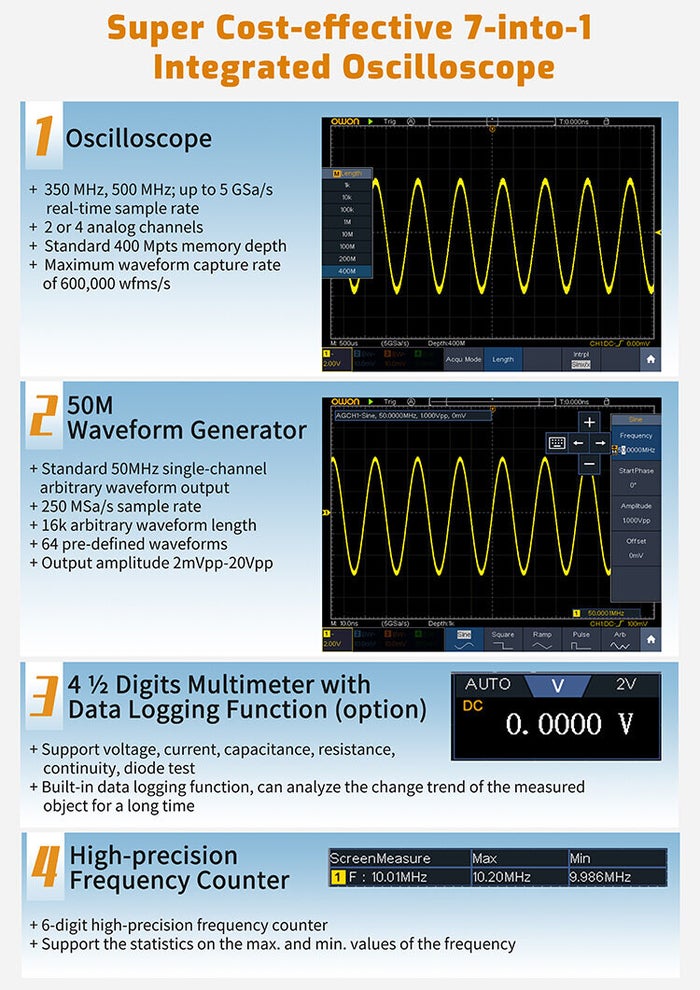
OWON calls the XDS4000 a “7-into-1” oscilloscope. Five of the seven are standard; the multimeter and the protocol decoding are factory options.
Oscilloscope
350 or 500 MHz, up to 5 GSa/s, 400M record and 600,000 wfms/s.
50 MHz generator
Single-channel 14-bit arbitrary waveform generator, 250 MSa/s, 16K memory — standard, not an option.
FFT spectrum analyzer
Real-time FFT over the full analogue bandwidth with four window functions.
Frequency counter
6-digit counter with max/min statistics.
Bode plot
Sweeps the generator and plots gain and phase — loop-stability testing without a network analyser.
4½-digit multimeter
option20,000-count DMM with a data logger: 0.5–10 s sampling, 3 days to internal memory or 30 days to a USB drive.
Protocol analysis
optionTrigger on and decode UART/RS232, I²C, SPI and CAN.
Why the XDS4000
Four things you do not get on a mid-range bench scope.
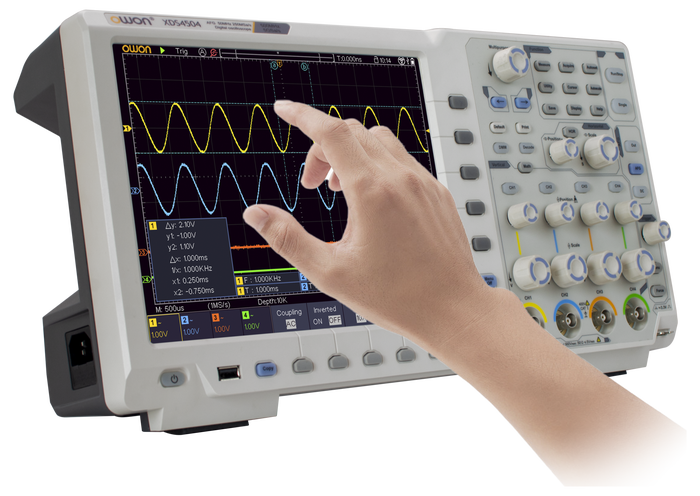
10.4-inch multi-touch
The largest screen in the OWON benchtop range, and a real capacitive multi-touch panel: pinch to zoom the timebase, drag cursors and swipe through menus. Every traditional knob and key is still there, so nothing forces you to work through the screen.
A large multi-touch display with pinch-zoom and drag, that also accepts a mouse and keyboard.
Spectrum work is reading detail in a trace. A bigger, higher-resolution screen means markers, limit lines and the trace itself stay legible at the same time, and dragging a span is faster than stepping a value with a knob.
In practice: Zooming into a 200 kHz slice of a 3 GHz span by pinching, rather than typing a new centre frequency and span.
Generator built in as standard
A 50 MHz single-channel arbitrary waveform generator with 250 MSa/s, 14-bit resolution, 16K memory and 46 built-in shapes — standard equipment, not a paid module. The waveform-cloning function turns a captured trace straight into a generator output.
Click to enlarge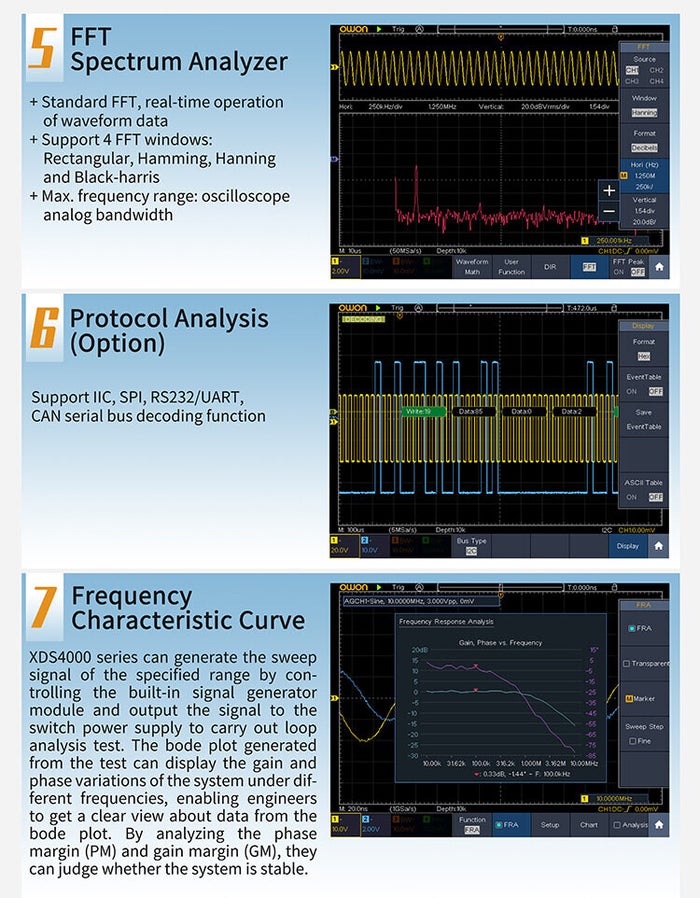
Bode plot and analysis
Sweep the built-in generator and the XDS4000 plots gain and phase against frequency — loop-stability testing on a switching supply without a network analyser. FFT with four window functions, protocol decoding and a 6-digit counter round out the analysis set.
Click to enlarge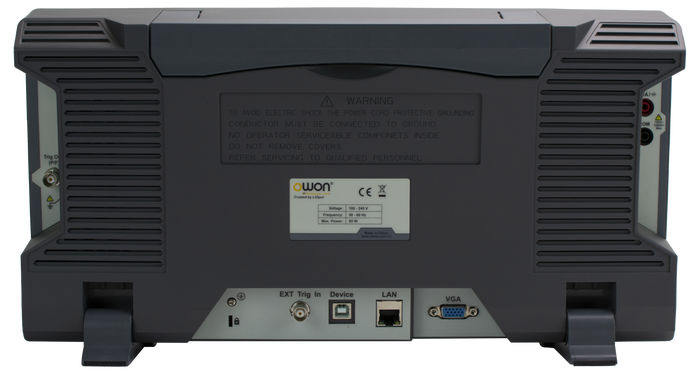
Deep memory and connectivity
Up to a 400M-point record, and USB host and device, LAN, VGA, EXT Trig In and Trig Out (Pass/Fail) on the back. SCPI over USB TMC or LAN puts the instrument into an automated rack; PictBridge prints a screen straight to a printer.
Record length is how many samples the instrument stores per acquisition. Together with the sample rate it sets how long a window you can capture without dropping resolution.
Sample rate and time window trade against each other for a fixed memory. Deep memory is what lets you hold a long sequence at full rate instead of choosing between seeing the whole frame and seeing the edges inside it.
In practice: Capturing a full 20 ms mains cycle while still resolving a 100 ns switching spike inside it needs deep memory; a shallow buffer forces you to pick one or the other.
Who it’s for & best applications
This is a scope for work where bandwidth, memory depth and capture rate all matter at once.
- High-speed digital and fast-edge design up to 500 MHz
- Switching power-supply development — including loop stability with the built-in Bode plot
- Long captures of intermittent faults across a 400M record
- R&D and validation labs that want one instrument instead of four
- Automated test racks over SCPI (USB TMC or LAN)
- Rise/fall time and jitter on fast edges (≤ 0.7 ns rise time at 500 MHz)
- Gain and phase margin measurement on a feedback loop
- Stimulus-response testing with the built-in 50 MHz generator
- Spectrum checks with FFT across the full analogue bandwidth
- Serial-bus debugging: UART/RS232, I²C, SPI, CAN
- Four-channel timing on three-phase drives and multi-rail supplies
Choose your model
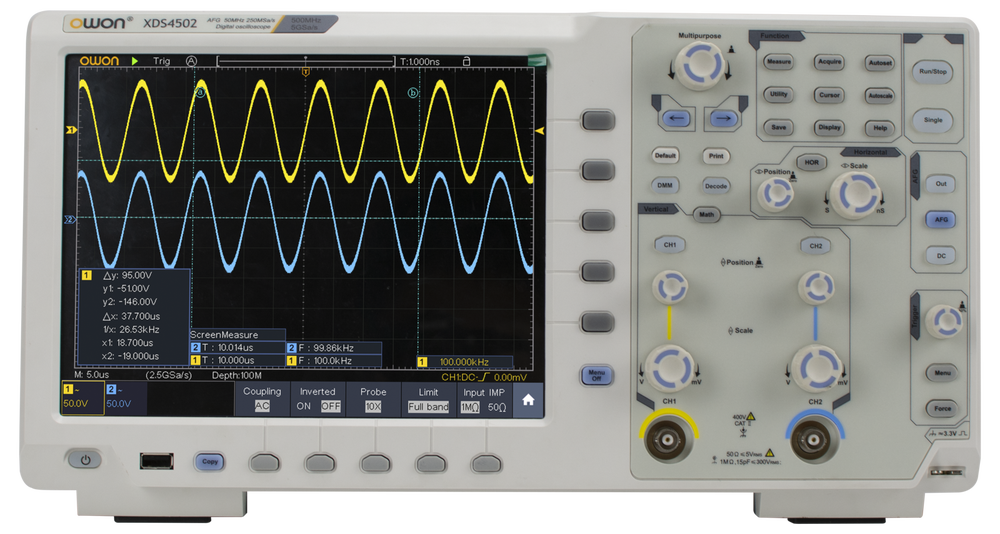
Two decisions: 350 or 500 MHz of bandwidth, and 2 or 4 channels. Everything else — 5 GSa/s, the 400M record, the 600,000 wfms/s capture rate, the 10.4-inch touch screen and the built-in generator — is the same across the family. The model number reads bandwidth then channels: XDS4352 is 350 MHz with 2 channels, XDS4504 is 500 MHz with 4.
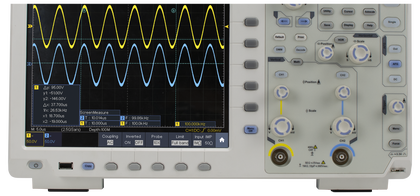
XDS4352
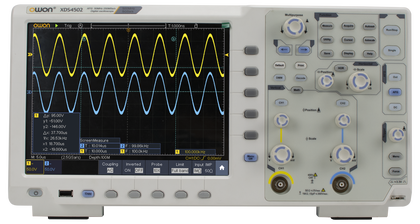
XDS4502
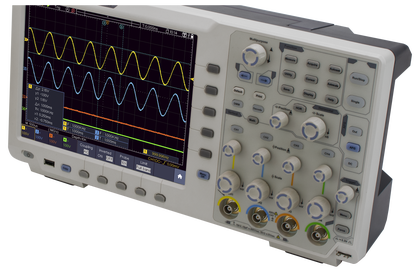
XDS4354
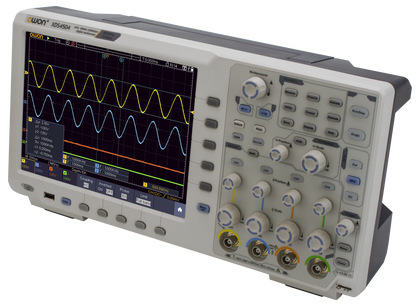
XDS4504
 XDS4352350 MHz25 GSa/s400M (1 ch)
€1592 on request
XDS4352350 MHz25 GSa/s400M (1 ch)
€1592 on request  XDS4502500 MHz25 GSa/s400M (1 ch)
€1858 on request
XDS4502500 MHz25 GSa/s400M (1 ch)
€1858 on request 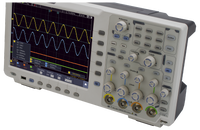 XDS4354350 MHz45 GSa/s400M (1 ch)
€1990 on request
XDS4354350 MHz45 GSa/s400M (1 ch)
€1990 on request 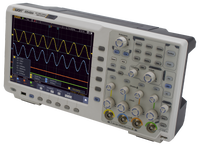 XDS4504500 MHz45 GSa/s400M (1 ch)
€2654 on request
XDS4504500 MHz45 GSa/s400M (1 ch)
€2654 on request
Sample rate and record length are shared across the running channels: 5 GSa/s and 400M on one channel, 2.5 GSa/s and 200M on two, and on the 4-channel models 1 GSa/s and 100M with all four on. Prices include VAT and are indicative — these are current OWON products that we order in, so ask us for a firm quote and lead time.
Specifications
Shared across the XDS4000 series; bandwidth, channel count and rise time depend on the model.
| Acquisition | |
| Bandwidth | 350 MHz (XDS4352, XDS4354) · 500 MHz (XDS4502, XDS4504) |
| Channels | 2 (XDS4352, XDS4502) · 4 (XDS4354, XDS4504) |
| Vertical resolution | 8-bit |
| Real-time sample rate | 5 GSa/s (1 ch) · 2.5 GSa/s (2 ch) · 1 GSa/s (4 ch, on the 4-channel models) |
| Max record length | 400M (1 ch) · 200M (2 ch) · 100M (4 ch) |
| Waveform capture rate | 600,000 wfms/s |
| Rise time (typical) | ≤ 0.7 ns at 500 MHz · ≤ 1 ns at 350 MHz |
| Horizontal scale | 500 ps/div – 1000 s/div (1-2-5 steps) |
| Timebase accuracy | ±2.5 ppm max (25 °C ±5 °C) |
| Acquisition modes | Normal, Peak detect, Averaging |
| Display grading | Multi-level grayscale and colour-temperature display |
| Input | |
| Vertical sensitivity | 1 mV/div – 10 V/div |
| Input impedance | 1 MΩ ±2% ‖ 15 pF ±5 pF, or 50 Ω ±2% |
| Max input voltage | 400 V (DC + AC peak) |
| Input coupling | DC, AC, Ground |
| Bandwidth limit | 20 MHz / full bandwidth |
| Channel isolation | 50 Hz: 100:1 · 10 MHz: 40:1 · 500 MHz: 20:1 |
| Channel-to-channel delay | 150 ps (typical) |
| DC gain accuracy | ±3% at 1 mV/div · ±2% at ≥ 2 mV/div |
| Trigger & analysis | |
| Trigger types | Edge, Video, Pulse, Slope, Runt, Windows, Timeout, Nth Edge, Logic, Pattern, Duration, Delay, Setup/Hold, UART/RS232, I²C, SPI and CAN |
| Trigger holdoff | 100 ns – 10 s |
| Serial decoding | UART/RS232, I²C, SPI, CAN — optional decode kits |
| Automatic measurements | Period, frequency, mean, PK-PK, RMS, cycle RMS, min/max/top/base, amplitude, overshoot, preshoot, rise/fall time, pulse widths, duty cycles, delay and phase A→B, FRR/FRF/FFR/FFF, LRR/LRF/LFR/LFF, edge and pulse counts, area and cycle area |
| Cursors | ΔV, ΔT, ΔT & ΔV between cursors, auto cursor |
| Waveform maths | +, −, ×, ÷, FFT, FFTrms, Intg, Diff, Sqrt, user-defined function, digital filters (LP / HP / BP / BR) |
| Waveform storage | 100 waveforms |
| Frequency counter | 6-digit, with max/min statistics |
| Bode plot | Standard — sweeps the built-in generator and plots gain and phase |
| Built-in generator (standard) | |
| Output | 1 channel, 50 MHz max, 250 MSa/s, 14-bit, 16K waveform memory |
| Amplitude | 2 mVpp – 5 Vpp (≤ 50 MHz) · 2 mVpp – 20 Vpp (≤ 25 MHz) |
| Offset | ≤ ±2.5 V (Vpp ≤ 5 V) · < ±7.5 V (Vpp > 5 V) |
| Waveforms | Sine, square, ramp, pulse + 46 built-in arbitrary shapes and user-defined waveforms |
| Multimeter (option) & general | |
| Multimeter | 4½-digit, 20,000 count; DC 20 mV – 1000 V, AC 200 mV – 750 V, DC/AC current to 20 A, 200 Ω – 100 MΩ, 2 nF – 20 mF, diode and continuity |
| Display | 10.4-inch multi-touch colour LCD, 800 × 600, 65,536 colours |
| Interfaces | USB host, USB device, LAN, VGA, Trig Out (Pass/Fail), EXT Trig In; PictBridge printing; SCPI over USB TMC and LAN |
| Power | 100 – 240 VAC, 50/60 Hz, CAT II, < 65 W; fuse 2 A T-class 250 V |
| Environment | Operating 0 – 40 °C, storage −20 – 60 °C, ≤ 90% RH, fan cooled |
| Dimensions & weight | 422 × 226 × 135 mm · ≈ 5 kg |
From the official OWON XDS4000 series technical specifications (v1.0.1); subject to change, errors & omissions excepted.
In the box
Supplied as standard; the dashed item ships with the optional multimeter module.
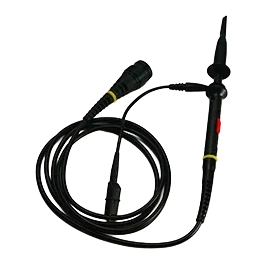
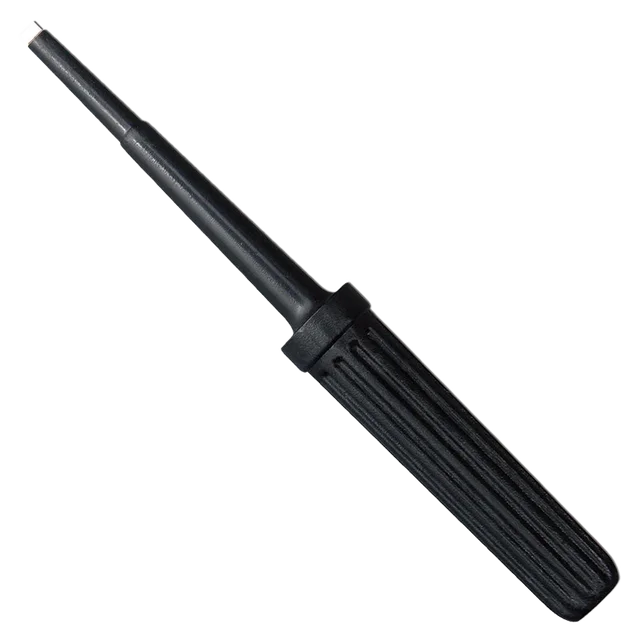
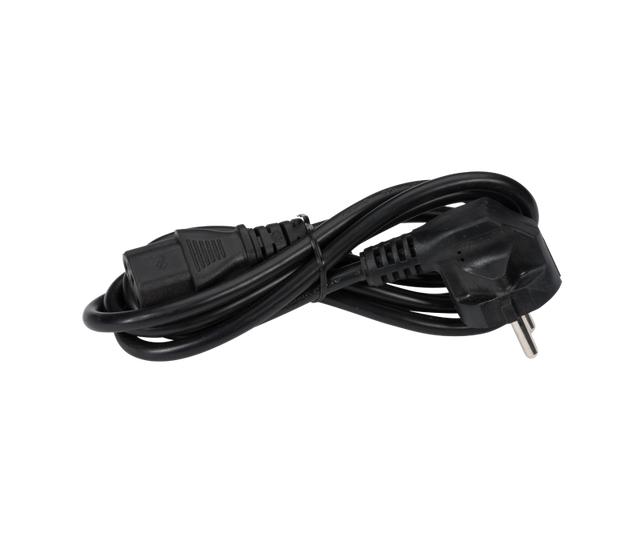
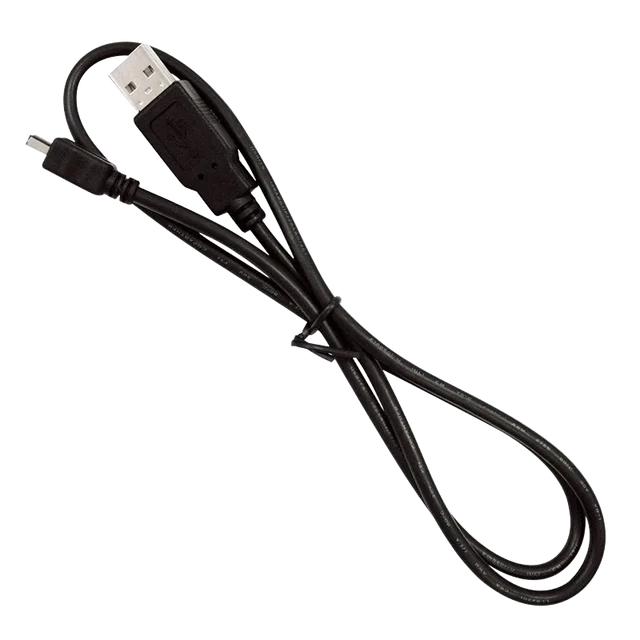

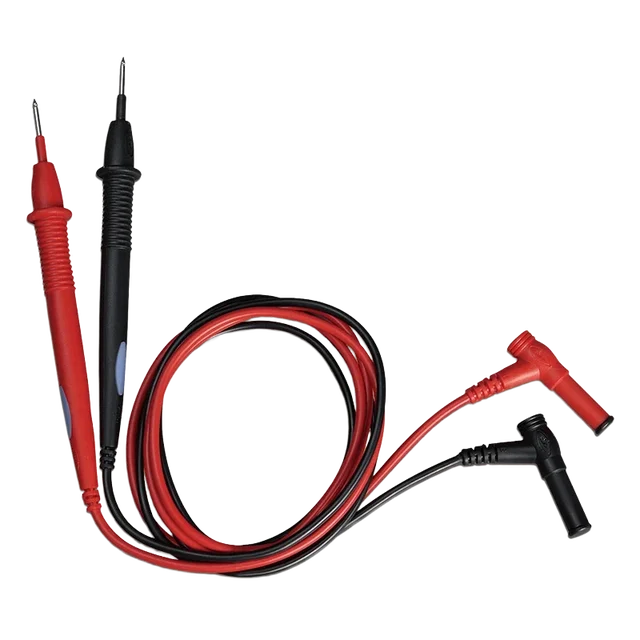
optional
Box contents subject to final delivery. The PC software is a free download below.
Related series & accessories
Other OWON benchtop ranges, and the parts that go with your XDS4000.
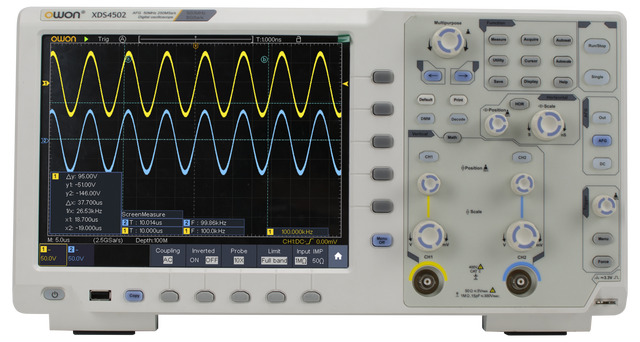
XDS3000 — n-in-1
60–300 MHz, 2 or 4 channels, switchable 8/12/14-bit, with generator, multimeter, Wi-Fi and battery as built-in options.
View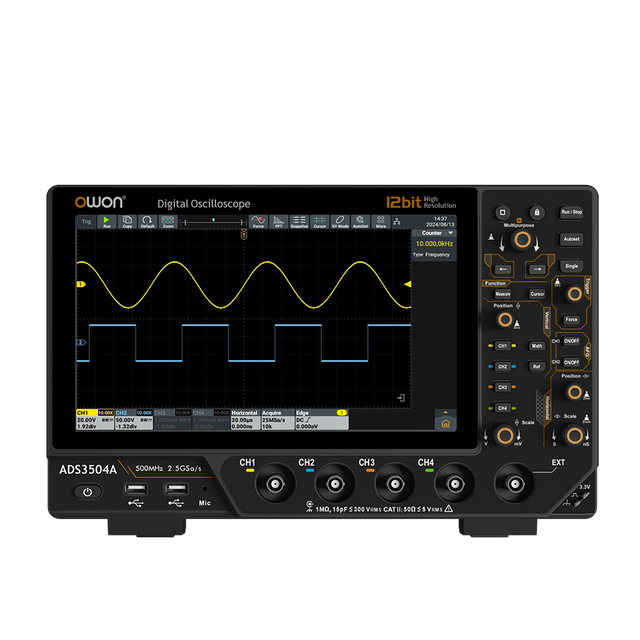
ADS3000A — 12-bit
100–500 MHz with a 12-bit ADC and a 10.1-inch Android touchscreen, from €611.
View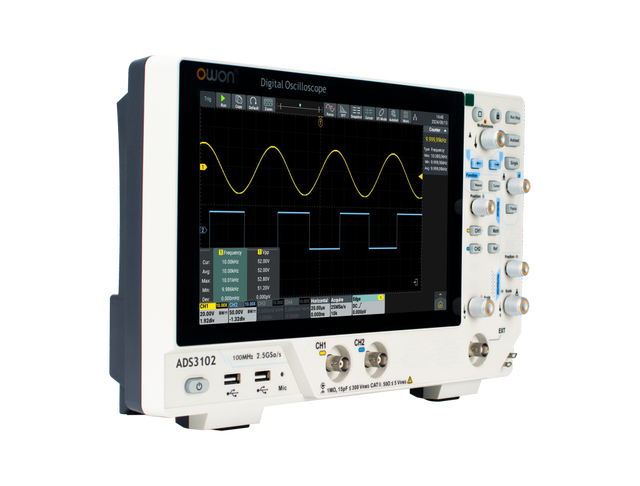
ADS3000 — multifunction
4th-generation 100–500 MHz multifunction benchtops, from €485.
ViewProbes & accessories
Passive probes, current probes, high-voltage differential probes and cables.
ViewConfigure your XDS4000
Tell us the bandwidth and channel count you need, and whether you want the multimeter module and the serial-decode kits fitted — we will quote the exact build with a lead time.
Downloads
Official OWON documentation and Windows software for the XDS4000 series.
Also: OWON newDSO PC software for Windows (ZIP) and the factory XDS4000 product page.