

OWON TAO3104 4CH 100MHz Tablet Digital Oscilloscope


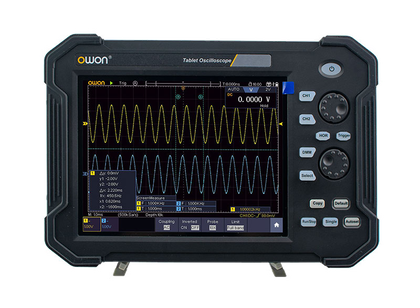
The OWON TAO3104 100MHz Digital tablet oscilloscope with a Touchscreen 8'' LCD is the new portable Tablet USB Oscilloscope series that OWON has brought to the test and measurement market that requires a more portable and flexible solution in the field.
100 MHz across four channels
The OWON TAO3104 is the 100 MHz, 4-channel member of the TAO3000 tablet family — four independent inputs on an 8″ multi-touch capacitive display, in a rugged, battery-powered body built for the field.
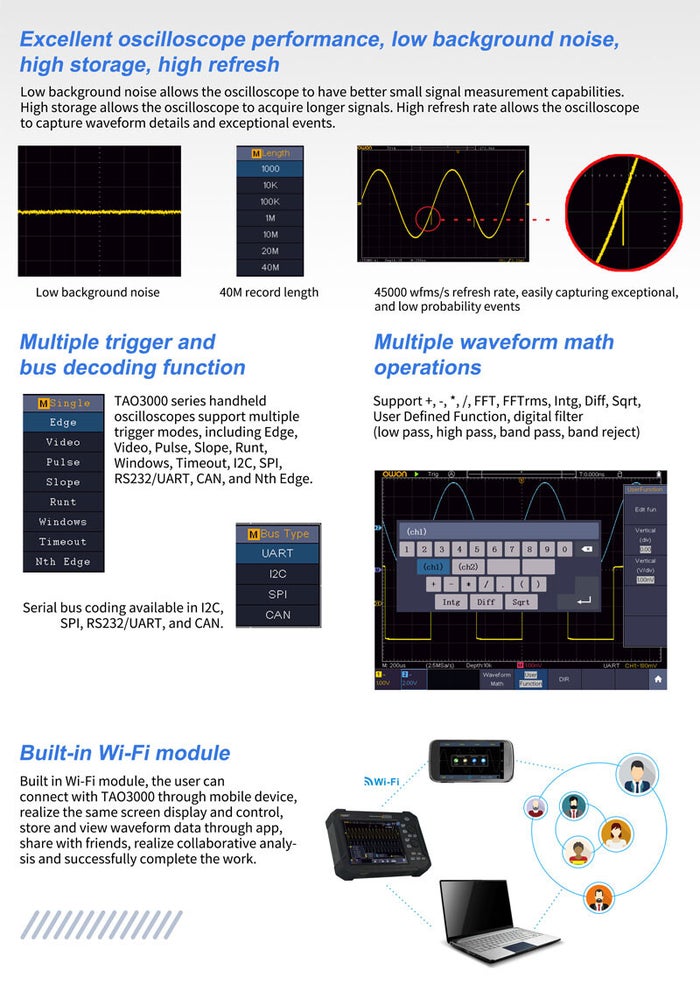
With 1 GSa/s real-time sampling, up to 40 Mpts of record length and a 45,000 wfms/s refresh rate, it captures long sequences without losing edge detail. Multi-level triggers and optional I²C, SPI, UART and CAN decoding turn it into a genuine embedded-debug tool.
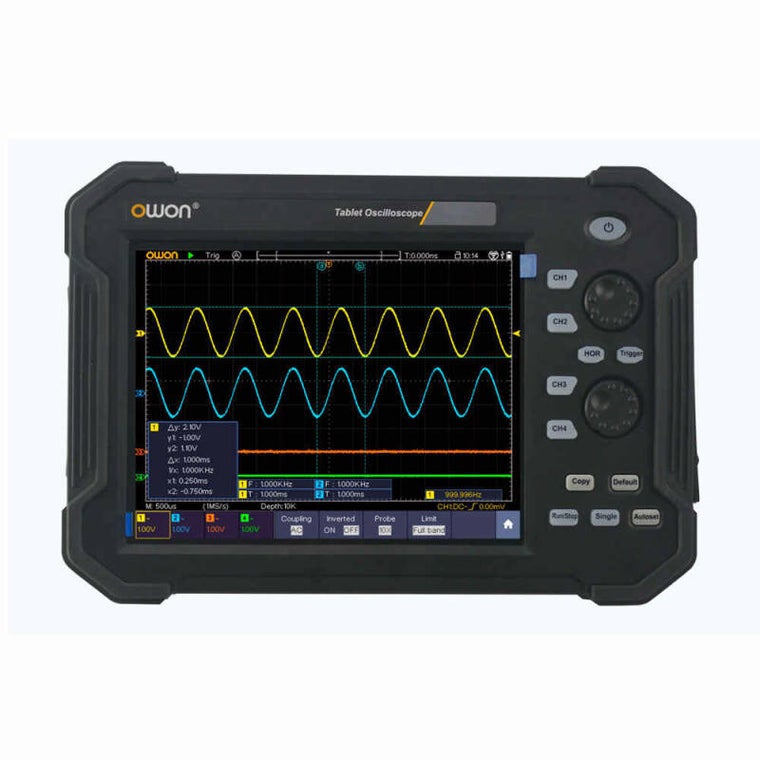
Why the TAO3104
Four channels, an 8-inch touchscreen and a rugged, battery-powered body — a full bench oscilloscope you can carry to the fault.
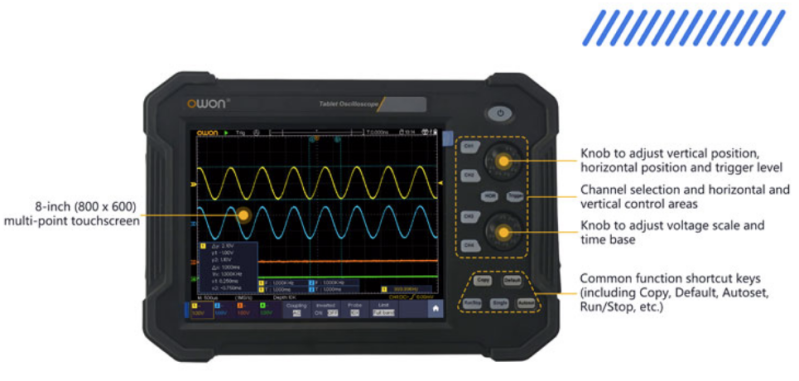
8″ touch, real knobs
An 800 × 600 multi-touch display for pinch, swipe and tap — with rotary knobs for vertical, horizontal and trigger, and shortcut keys for Autoset, Run/Stop, Single and Copy.
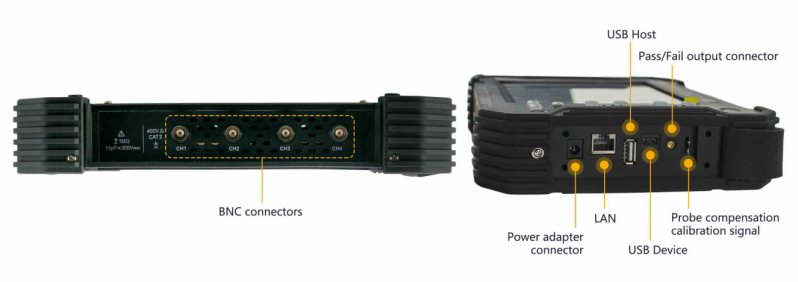
Four BNC channels
Four independent 100 MHz inputs on one panel, with LAN, USB host, USB device, a Pass/Fail trigger output and the probe-compensation signal on the side.
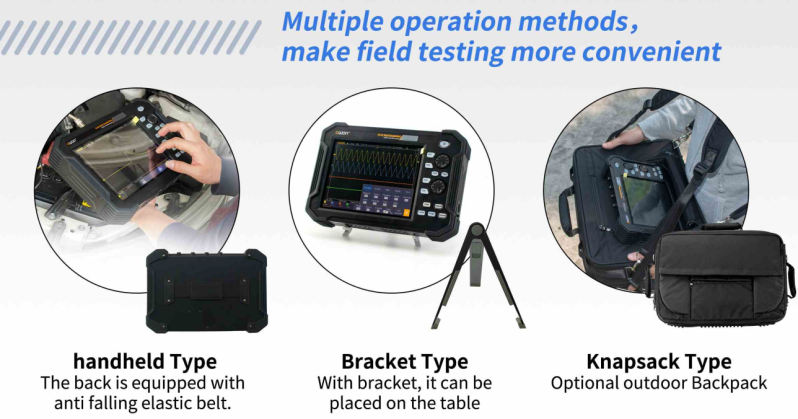
Built for the field
An anti-slip elastic belt on the back for one-handed use, a fold-out bracket to stand it on the bench, and an optional shoulder bag for the trip in between.
Deep memory, fast refresh
A low noise floor, up to 40 Mpts of record length and a 45,000 wfms/s refresh rate catch long and rare events, with ten trigger types, waveform math and optional serial-bus decoding.
Who it’s for & best applications
With 100 MHz across 4 channels on a touchscreen you can carry, the TAO3104 is made for embedded and bus debugging, multi-rail power sequencing and general four-channel bench and field work.
- Field-service & maintenance engineers
- Embedded, power & general electronics benches
- Education, training labs & advanced makers
- Production test and automated (SCPI / LabVIEW) setups
- Anyone who prefers a touchscreen to a wall of knobs
- General electronics, audio & power-supply debugging
- Microcontroller & embedded development
- I²C, SPI, UART/RS232 & CAN bus decoding (optional)
- Signals up to 100 MHz
- Watching four rails, buses or phases at the same time
TAO3104 specifications
From the official OWON TAO3000 four-channel series specification table and OWON product catalogue.
| Oscilloscope | |
| Bandwidth | 100 MHz |
| Channels | 4 analog |
| Vertical resolution | 8-bit |
| Real-time sample rate | 1 GSa/s (max) |
| Record length | 40 Mpts (max) |
| Waveform refresh rate | 45,000 wfms/s |
| Acquisition modes | Normal, peak detect, averaging |
| Timebase | 1 ns/div – 1000 s/div, 1-2-5 steps |
| Vertical sensitivity | 1 mV/div – 10 V/div (at input) |
| Input impedance | 1 MΩ ±2%, in parallel with 15 pF ±5 pF |
| Input coupling | DC, AC, GND |
| Max input voltage | 400 V (DC + AC peak) · CAT II, ≤ 300 Vrms |
| Probe attenuation | 0.001X – 1000X, 1-2-5 steps |
| Trigger types | Edge, Video, Pulse, Slope, Runt, Windows, Timeout, Nth Edge, Logic, UART/RS232, I²C, SPI and CAN (optional) |
| Trigger modes | Auto, Normal, Single · holdoff 100 ns – 10 s |
| Serial bus decoding | I²C, SPI, UART/RS232, CAN (optional) |
| Waveform math | +, −, ×, ÷, FFT, FFTrms, Intg, Diff, Sqrt, user-defined function, digital filter |
| Measurements | Full automatic set (period, frequency, mean, RMS, Vpp, rise/fall time, pulse width, duty, delay, phase, edge counts, area…), cursors, frequency counter |
| Waveform storage | 100 waveforms |
| Display, interfaces & general | |
| Display | 8″ colour TFT LCD, 800 × 600, 65,536 colours, multi-touch capacitive |
| Interfaces | USB host, USB device, PictBridge printing, LAN, Pass/Fail trigger output, Wi-Fi (optional) |
| Automation | SCPI and LabVIEW; mobile app over Wi-Fi for screen mirroring and control |
| Battery | Built-in rechargeable lithium battery for cable-free field use |
| Dimensions | 270 × 191 × 48 mm |
| Weight | Approx. 1.7 kg (without accessories) |
Subject to change, errors & omissions excepted.
In the box
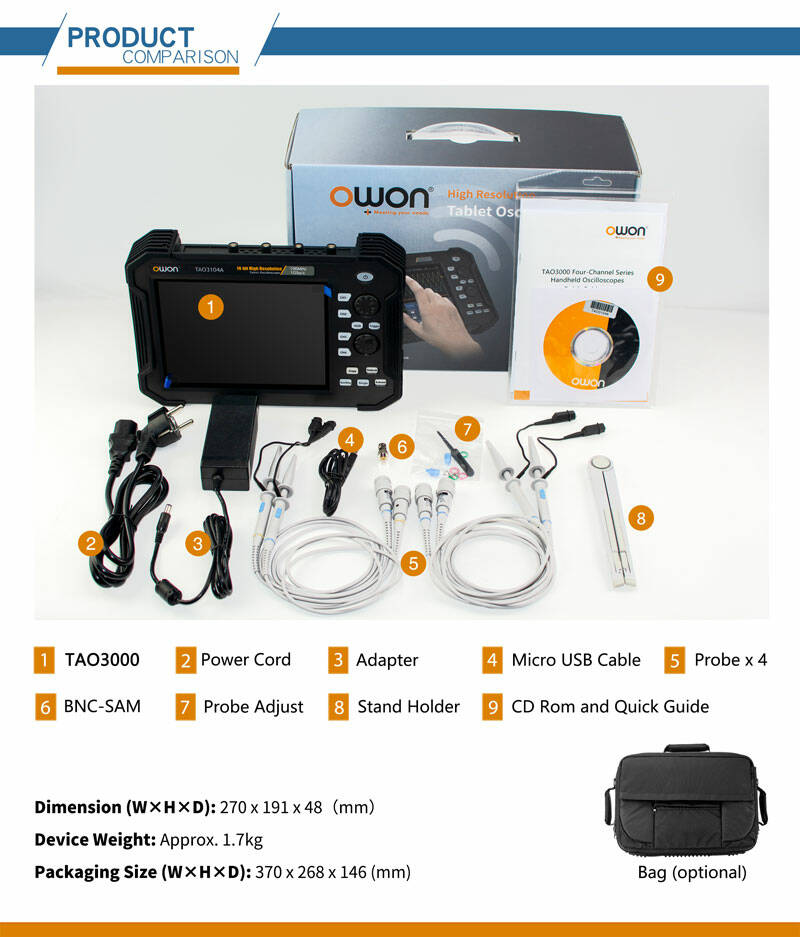
The TAO3104 ships ready to measure — including four oscilloscope probes, one for every channel.
- Oscilloscope probes × 4
- BNC-SAM adapter and probe adjuster
- AC-DC power adapter and mains power cord
- Micro-USB cable
- Fold-out stand holder
- CD-ROM and quick guide
- Padded shoulder bag (optional)
Accessories subject to final delivery. The PC software and mobile app are free downloads — see the Downloads section below.
Other models in the series
Want the lowest noise floor and the finest amplitude detail? The TAO3104A adds a switchable 8 / 12 / 14-bit ADC on the same 100 MHz platform. Every TAO3000 shares the same 8″ multi-touch platform, 1 GSa/s sampling, 40 Mpts memory and 45,000 wfms/s refresh rate — only bandwidth, channel count and ADC resolution differ.
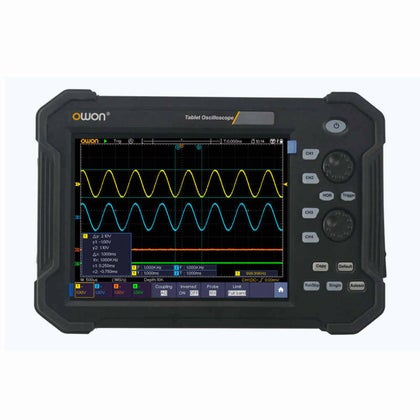
TAO3074
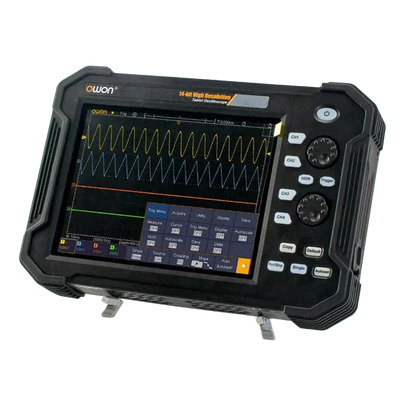
TAO3074A
TAO3104A
Need a built-in multimeter?
The 2-channel TAO3072, TAO3102 and TAO3122 add a 4½-digit multimeter and data logger to the same tablet.
ViewQuestions about the TAO3104?
Tell us your fastest signals, how many channels you need and whether the high-resolution ADC would help — we’ll confirm the TAO3104 is the right pick, or point you to a better fit in the OWON range.
Downloads
Official OWON documentation and software for the TAO3104.
OWON does not publish a separate four-channel user manual; the quick guide above covers operation, and the SCPI protocol document covers remote programming.